Kansai Nerolac tests paint strength with bold near space experiment
Kansai Nerolac sends its exterior paint to near space, showcasing durability through extreme testing and redefining how brands prove product performance beyond traditional methods.
 Anupriya
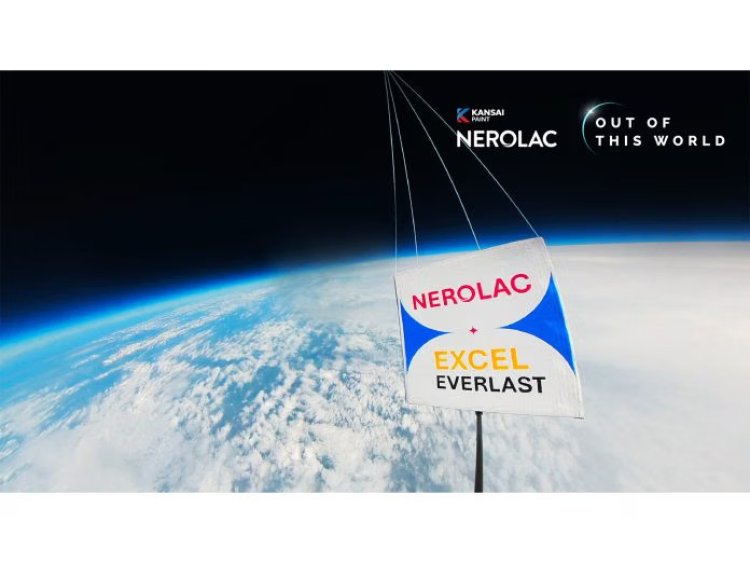
Kansai Nerolac has taken a rather unusual route to prove a very familiar claim. Instead of relying on lab tests or controlled demonstrations, the brand decided to test its paint where conditions are anything but controlled, near space.
In a campaign that blends science with storytelling, the company sent its Excel Everlast exterior paint up to an altitude of nearly 86,000 feet using a stratospheric balloon. At that height, the environment becomes extremely hostile, with freezing temperatures, intense ultraviolet radiation, and drastically reduced air pressure.
It is the kind of setting that pushes materials to their limits. And that is exactly what Kansai Nerolac wanted.
The idea behind the experiment was simple. If the paint can withstand such extreme conditions, it should easily handle everyday weather challenges back on Earth. It is a bold way to demonstrate durability, turning what is usually a technical claim into a visual and experiential narrative.
The payload, coated with the paint, was launched into the upper atmosphere and later retrieved. According to the brand, the surface showed no visible damage, reinforcing the product’s promise of long lasting protection.
While the science behind the experiment is impressive, the marketing thinking behind it is equally noteworthy.
Paint advertising has traditionally relied on claims backed by lab data or simulated conditions. These methods may be effective, but they are not always easy for consumers to relate to. Kansai Nerolac’s approach changes that by creating a story people can actually visualise.
Instead of explaining durability, the brand shows it in action. And not just in everyday conditions, but in an environment far more extreme than anything a building would typically face.
The campaign film captures the entire journey, from preparation and launch to the return of the payload. This documentation adds a layer of authenticity, making the experiment feel real rather than conceptual.
At the core of the product is nano silica technology, which enhances strength and helps prevent cracks. The paint is also positioned as a long term solution, backed by a 20 year warranty. By putting it through such a rigorous test, the brand is effectively reinforcing these claims in a way that stands out.
There is also a larger shift reflected in this campaign. Today’s consumers are more aware and more skeptical of marketing claims. Simply stating that a product is durable is no longer enough. Brands need to show proof, and sometimes that proof needs to be dramatic enough to capture attention.
This is where Kansai Nerolac’s experiment works. It is not just about validation, it is about creating a memorable moment. The idea of paint being tested in near space is unexpected, which makes it easier for people to recall.
At the same time, the campaign stays rooted in a clear insight. Exterior paints are designed to withstand harsh environmental conditions like heat, rain, and pollution. By testing the product in an environment far more extreme, the brand strengthens its core message.
Of course, no building will ever face near space conditions. But that contrast actually works in the brand’s favour. It makes everyday challenges seem less daunting, reinforcing the idea that the paint is more than capable.
From a creative standpoint, the campaign stands out in a category that often feels repetitive. It brings scale, imagination, and a sense of adventure to a product that is usually seen as purely functional.
For Kansai Nerolac, this is not just about launching a product. It is about redefining how product performance is communicated. It shows a willingness to move beyond traditional methods and explore new ways of storytelling.
In the end, the campaign leaves a strong impression. It suggests that when it comes to durability, some claims are better demonstrated than described.
And in this case, the proof has quite literally reached new heights.