Amul Case Study: Business Model, Marketing Strategy and Success Story
Amul’s success story is built on cooperative ownership, smart marketing and a strong dairy network.
 SociapaHQ
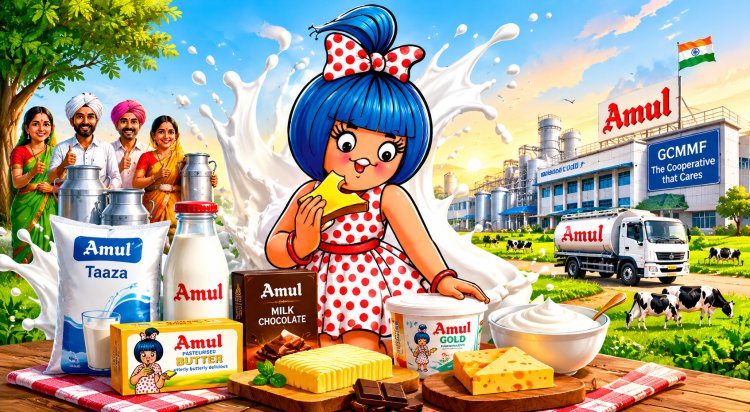
Amul is not only one of India's most recognised dairy brands but a cooperative movement that transformed the country's dairy industry and improved the livelihoods of millions of farmers. The story of Amul, from its roots in Gujarat to a household name in India, is one of innovation, community empowerment and strategic growth.
In this case study, we take a look at the birth of Amul, its unique business model, the reasons behind its success and the marketing strategies that have kept it relevant for generations.
The Origins of Amul
Amul was set up in 1946 in Anand, Gujarat, when dairy farmers were suffering under the thumb of middlemen who bought milk at low prices and sold it at a huge profit.
To combat this system, local farmers established a cooperative that would enable them to market their milk as a group and receive fair compensation.
Dr Verghese Kurien spearheaded the movement which gathered momentum with the adoption of modern technology, professional management practices and innovative dairy processing techniques. His efforts helped lay the foundation of India’s White Revolution which eventually helped make the country the world’s largest milk producer.
Out of this movement Amul emerged as a symbol of empowerment, equity and rural development.
Also Read: AI Tricks Industry As Fake Amul Ad Goes Viral Fast
Amul’s Business Model
1. Umbrella Brand Strategy
Amul is a master brand comprising more than 50 dairy products, such as milk, butter, cheese, chocolates and ice cream.
Such a strategy of umbrella-branding allows the company to benefit from its quality brand image across different product categories, while maintaining high brand recall and low marketing costs.
2. Ownership and Governance of Farmers
Amul is not a regular corporation but is owned by the dairy farmers who supply milk to the cooperative.
The democratic governance structure permits elected representatives to take part in decision-making. Women are also taking on a significant leadership role at the village level, contributing to the cooperative’s bottom-up management.
3. Revenue Model
Amul’s business model is based on scale, not maximising profits.
The milk is produced by millions of farmers and processed efficiently and sold directly to consumers. The co-op is designed to return better profits to farmers and keep products affordable to consumers.
4. Supply Chain Excellence
Amul’s supply chain is one of the most efficient in the dairy sector.
Milk collection begins daily at village societies, where quality checks are conducted immediately. Refrigerated transportation moves the milk to district processing facilities, after which products are distributed through a network of over 10,000 distributors and approximately one million retailers.
5. Three-Tier Cooperative Structure
Amul’s operational success is driven by its three-level cooperative framework:
- Village societies manage milk collection and farmer payments.
- District unions handle processing, packaging and infrastructure development.
- The Gujarat Cooperative Milk Marketing Federation (GCMMF) oversees branding, marketing and nationwide distribution.
Also Read: Amul crosses ₹1 lakh crore proving dairy dreams scale big
Key Drivers Behind Amul’s Success
1. The Amul Girl
One of the most enduring advertising icons in India, Amul Girl was created in 1966 by Sylvester daCunha.
The mascot, known for her witty commentary on current events, has helped the brand remain culturally relevant with a consistent identity across generations.
2. Product Innovation and Diversification
Amul started with butter and soon diversified into milk, cheese, yoghurt, ice cream and several other categories.
While the company remains true to its dairy roots, it is also developing new products to adapt to changing consumer preferences.
3. Robust Supply Chain
Amul gathers milk from some 3.6 million farmers in 18,700 villages, twice a day.
Its direct procurement model eliminates middlemen, facilitates quality control and increases operational efficiency.
This system proved to be resilient in the COVID-19 pandemic as Amul continued to function without any disruption, despite the disruption that was being experienced widely.
Also Read: 'Amul family mourns': Sylvester daCunha's tributes come in
Amul’s Marketing and Branding Strategy
1. Product Strategy
Amul’s expansion plan has been based on the adjacent dairy categories.
The company started with butter and milk and gradually expanded into cheese, yoghurt, ice cream and chocolates.
It has a portfolio of products ranging from value to premium for different consumer segments.
2. Pricing Strategy
The company has a value-for-money pricing policy.
The products are priced in such a way that the farmers get their fair returns and still the products are affordable to the common households.
Amul focuses on growth driven by volume and consumer trust rather than high margins.
3. Distribution Strategy
Amul products are available through a wide range of channels, including supermarkets, neighbourhood stores, Amul parlours and online platforms.
In rural areas, the company works closely with local retailers and cooperative networks to ensure accessibility.
Amul’s Digital Marketing Strategy
1. Social Media Presence
Amul uses Instagram, Facebook and YouTube to engage modern consumers.
The brand regularly shares Amul Girl topical creatives, recipes and product-related content while maintaining a straightforward and product-centric approach.
2. Moment Marketing
Amul is widely recognised as a pioneer in moment marketing.
The company quickly responds to major events, including cricket tournaments, movie releases and national developments, with timely Amul Girl creatives that generate significant engagement and organic reach.
3. Adapting During COVID-19
During the pandemic, Amul strengthened communication around product availability and safety measures.
The company expanded delivery options, maintained operational continuity and introduced products such as turmeric milk to address evolving consumer needs.
4. Influencer Collaborations
Instead of relying heavily on celebrities, Amul collaborates with food bloggers and home chefs to showcase practical product applications.
The company also conducts recipe-focused digital sessions, particularly during festive seasons.
Also Read: Kolkata Knight Riders and Amul Protein Bring Back “Train Like a Knight” for IPL 2026
How Amul Reinvented Dairy for Modern Consumers
1. Transforming Consumer Perceptions
Amul played a major role in changing perceptions of packaged dairy products in India.
By maintaining quality and reliability, the company convinced consumers that packaged dairy could be both convenient and trustworthy.
2. Expansion into New Categories
The company expanded from basic dairy products into categories such as processed cheese, ice cream and chocolates.
Each category expansion enabled Amul to strengthen its presence while introducing consumers to new dairy-based products.
3. Catering to Regional Preferences
Recognising India's diversity, Amul develops products tailored to regional tastes.
Examples include sweeter butter variants in western India, saltier alternatives in southern markets and traditional regional products such as shrikhand and basundi.
Amul’s success is rooted in a combination of cooperative ownership, operational efficiency, product innovation and powerful branding.
What began as a farmer-led movement in Gujarat has evolved into one of India’s most trusted brands. Through its unique business model, efficient supply chain and emotionally resonant marketing, Amul has built a lasting connection with consumers while continuing to empower millions of dairy farmers.