India talks climate more than ever but only 10 percent feel ready to act
WeNaturalists report reveals India’s growing climate awareness but low action readiness, with only 10 percent feeling informed enough to act despite rising conversations.
 SociapaHQ
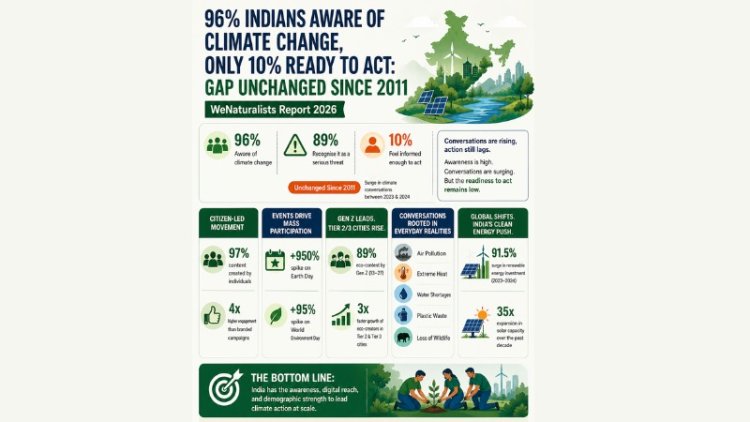
A new report by WeNaturalists points to a widening gap between climate awareness and real action in India. Titled India’s Climate Conversations & Action Report 2026, the study finds that while 96 percent of Indians are aware of climate change and 89 percent see it as a serious threat, only 10 percent feel informed enough to take meaningful action. That number has remained unchanged since 2011, despite a sharp rise in public discourse.
The report frames this moment as a shift from global conflict to local urgency, where geopolitical instability and climate risks are both pushing the issue into everyday conversations. But the rise in awareness is not converting into behaviour change. That disconnect is emerging as a central challenge for policymakers, brands, and platforms trying to drive climate participation at scale.
At the same time, the volume of climate conversations is growing fast, especially online. On WeNaturalists, nature-related content increased by 34 percent between 2023 and 2024. Early trends suggest 2025 is on track to surpass previous levels, already reaching 80 percent of last year’s total. The momentum is largely driven by individuals, with 97 percent of all content created by users rather than organisations.
This shift towards citizen-led content is also changing how engagement works. User-generated content is delivering up to four times higher engagement compared to branded campaigns, indicating that audiences are responding more to peer-driven narratives than institutional messaging. Participation is also heavily influenced by key calendar moments. Events like Earth Day saw spikes of up to 950 percent in activity, while World Environment Day recorded a 95 percent jump, showing how collective moments can act as triggers for conversation.
Amit Banka, Founder and CEO of WeNaturalists, describes the situation as a structural bottleneck rather than just an awareness issue. “India is at a defining moment in its climate journey. We have near-universal awareness, a billion people connected online, and a generation that is actively shaping the climate conversation. The real challenge now is turning this awareness into action,” he said. He added that the focus must shift from simply raising awareness to enabling action at scale, especially as climate risks intensify and global disruptions reshape energy realities.
For brands and media, this presents a clear signal. Awareness-led campaigns alone are no longer enough. The opportunity lies in designing interventions that help audiences move from intent to action. This could mean more practical storytelling, clearer calls to action, or platforms that enable participation rather than just consumption. The fact that user-generated content is outperforming branded efforts suggests that credibility is increasingly tied to relatability and lived experience.
For consumers, particularly younger, digitally active audiences, climate is becoming a daily conversation rather than an abstract issue. But the gap in actionable knowledge remains a barrier. Knowing climate change is real is not the same as knowing what to do about it. This is where information design, accessibility, and community-led education can play a bigger role.
Culturally, the report highlights an important shift. Climate is no longer confined to policy discussions or scientific forums. It is showing up in feeds, conversations, and shared moments. But without clear pathways to action, the risk is that it remains performative.
The next phase of climate communication in India will likely be defined by how effectively this gap is addressed. The conversation is already happening. The challenge now is making it count.