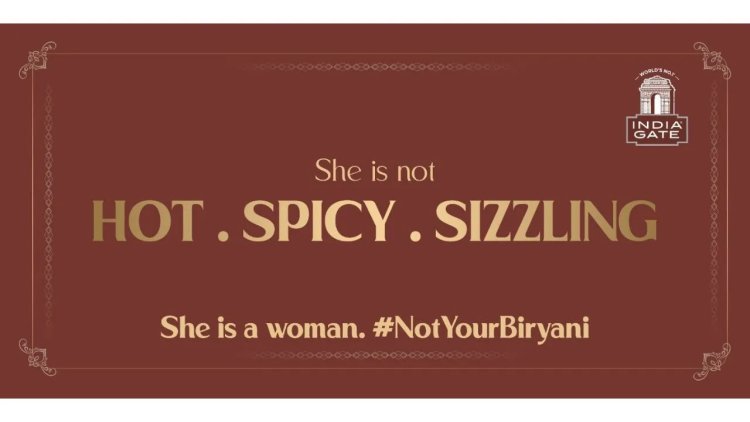
Some phrases slip into everyday conversations so easily that people rarely pause to think about them. India Gate’s latest Women’s Day campaign gently nudges audiences to do exactly that. With its new initiative titled #NotYourBiryani, the basmati rice brand turns a familiar cultural habit into a thought provoking message about language and respect.
The campaign draws attention to the way food related adjectives are casually used to describe women in social settings. Words like hot, spicy and sizzling may feel harmless when associated with dishes, but the brand highlights how these same expressions can become objectifying when used for people.
Instead of presenting the idea through a heavy or confrontational tone, the campaign uses wit and visual simplicity to make its point.
At the centre of the campaign is a creative visual designed like a restaurant menu. The layout resembles the kind of menu people might see at a dining table, but instead of listing dishes, it displays a series of descriptive words commonly associated with food. At first glance, the design appears playful and familiar.
Then the message becomes clear.
These are words meant for meals, not for women.
The visual ends with a sharp and memorable line that captures the essence of the campaign: She’s a woman, not your biryani.
The brilliance of the concept lies in its subtlety. Rather than directly criticising behaviour, the campaign invites viewers to reflect on how language shapes perceptions. Food metaphors are deeply embedded in casual conversations across cultures, and many people use them without realising the implications.
By placing those words back in a literal food context, the campaign cleverly highlights the difference between playful language and problematic expressions.
To extend the conversation beyond the visual, the campaign has been amplified through digital creators and influencers who are sharing their thoughts and experiences around the theme. Through posts, short videos and conversations, these voices encourage audiences to reflect on how everyday language can influence attitudes.
The hashtag #NotYourBiryani acts as the anchor of the campaign, inviting people to participate in discussions and share their perspectives online.
The initiative also includes public interaction formats where people are asked about their understanding of such expressions and whether they recognise their underlying implications. These conversations add a layer of realism to the campaign by capturing genuine reactions from everyday audiences.
Beyond digital platforms, the campaign also appears through outdoor displays that carry the menu inspired visual concept into public spaces. The simplicity of the design allows the message to be understood quickly, even by someone who encounters it for just a few seconds.
For India Gate, a brand that has long been associated with Indian kitchens and traditional meals, the campaign connects naturally with its identity. Food is a central part of social life in India, and the language around food often becomes part of everyday expressions.
By addressing this cultural overlap, the brand positions itself not only as a product used in cooking but also as a participant in broader social conversations.
Women’s Day campaigns frequently focus on achievements, empowerment stories or inspirational journeys. While those narratives remain important, India Gate’s approach takes a slightly different route. Instead of spotlighting milestones, it focuses on a small but meaningful shift in everyday behaviour.
Language may seem like a minor detail, but the words people use every day shape attitudes over time. A simple phrase repeated casually can influence how individuals are perceived or spoken about.
Through #NotYourBiryani, the brand encourages audiences to reconsider those everyday expressions and replace them with words that carry genuine respect.
In the end, the campaign leaves viewers with a message that is both clever and clear.
Some words belong on the menu.
And some definitely do not.

 Sandhya