WhatsApp Adds Group Message History to Ease New Member Onboarding
WhatsApp has rolled out Group Message History, allowing admins and members to share up to 100 recent messages with new participants while maintaining end-to-end encryption.
 SociapaHQ
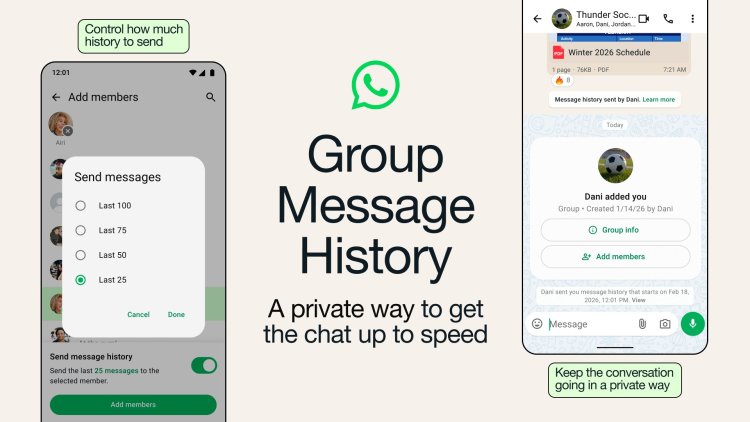
WhatsApp has introduced Group Message History, a feature aimed at reducing friction when adding new members to group chats. The update allows admins and participants to selectively share a limited batch of recent messages — between 25 and 100 — to help new members catch up without disrupting ongoing conversations.
For years, users have relied on informal workarounds to onboard new participants: screenshots, forwarded messages, or manual summaries. These methods often cluttered threads and raised privacy concerns. With this update, WhatsApp formalises that behaviour within its encrypted environment, adding structure and transparency to what was previously ad hoc.
The feature is not automatic. When a new member joins, existing participants are prompted with the option to share recent messages. Admins retain override control and can disable the feature entirely for their group. This opt-in design reflects a deliberate balance between usability and governance.
WhatsApp has confirmed that Group Message History maintains end-to-end encryption, consistent with all personal and group chats on the platform. Shared messages remain encrypted and visible only to intended participants. In addition, the platform has built in transparency markers: when history is shared, all group members are notified, and the shared messages appear visually distinct, complete with timestamps and sender details.
This dual emphasis on privacy and visibility is significant. In large or long-running group chats — whether for workplace coordination, school communities, event planning, or extended families — context gaps can derail discussions. By capping the number of messages and requiring user initiation, WhatsApp avoids converting group history into a full archive transfer tool. Instead, it positions the feature as a contextual bridge: limited, intentional, and governed.
The rollout also reinforces admin authority. Even if members can initiate history sharing, administrators retain the ability to control or disable the feature. As group chats become more complex and, in some cases, reach large community sizes, governance tools are becoming central to WhatsApp’s product evolution.
For Meta-owned WhatsApp, which serves more than two billion users globally, even incremental changes to group functionality can have outsized impact. In markets such as India, Brazil, and parts of Southeast Asia, group chats are central to digital interaction. They function not just as communication channels, but as operational hubs for small businesses, neighbourhood networks, and community coordination.
From a broader product perspective, the update reflects a shift toward structured continuity. Messaging platforms are increasingly focused not just on speed, but on maintaining conversational coherence. As attention spans shrink and threads move quickly, onboarding friction can weaken engagement. By institutionalising catch-up within the app, WhatsApp reduces dependency on manual intervention while preserving its encryption-first positioning.
The feature is being rolled out in phases and will gradually expand across devices and regions. As with most WhatsApp updates, adoption is expected to scale organically through usage rather than heavy promotion.
For users, the change is subtle but practical. For Meta, it reinforces a long-term strategy: refining group communication without compromising its privacy promise. In a crowded messaging landscape, small structural improvements often determine whether conversations remain manageable or spiral into chaos. Group Message History is WhatsApp’s latest attempt to keep that balance intact.