Pocket FM Says Creator Earnings Cross ₹300 Crore, Targets ₹1,000 Crore by 2026
Pocket FM says its creator economy has crossed ₹300 crore and is targeting ₹1,000 crore by 2026, powered by AI-driven storytelling tools and global localisation.
 SociapaHQ
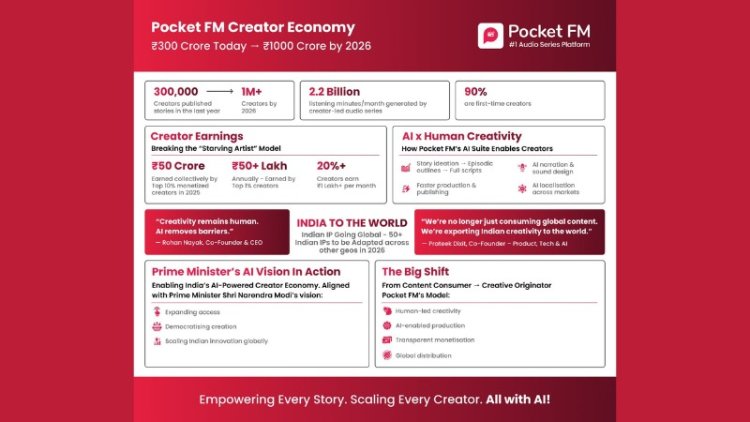
As policy conversations at the AI Impact Summit focus on India’s long-term artificial intelligence strategy, Pocket FM has released data positioning its creator ecosystem as a working example of AI-enabled scale. The audio storytelling platform said its creator economy has crossed ₹300 crore and is on track to reach ₹1,000 crore by 2026. Over 10% of its monetised creators have collectively earned more than ₹50 crore in 2025 alone, according to the company.
The platform also reported that over 300,000 creators published their first stories in the past year, with AI tools accelerating production cycles. It expects to reach one million creators by 2026. The numbers arrive amid wider debate about AI’s impact on creative work, where concerns over displacement sit alongside arguments for democratisation and access.
Pocket FM’s approach frames AI as infrastructure rather than replacement. “Pocket FM’s AI Suite reimagines this process as an AI-powered writers’ room built for serialised fiction,” said Prateek Dixit, Co-founder – Product, Tech and AI at Pocket FM. He outlined a multi-agent system: a Planner Agent to design long-term narrative arcs, a Context Agent to maintain continuity, and a Drama Agent to refine pacing and tension. The system operates in a loop of planning, drafting and refinement, while creators retain control over story direction.
The economic data suggests a shift in how digital storytelling is monetised. The company claims more than 20% of creators now earn over ₹1 lakh per month, while the top 1% earn upwards of ₹50 lakh annually. CEO Rohan Nayak said the platform aims to remove production and distribution bottlenecks that traditionally limited entry into publishing and entertainment. “Creativity remains human, and Pocket FM’s AI Suite is designed to remove barriers to bringing that creativity to life,” he said, adding that the model supports broader national ambitions around AI-enabled participation.
Nearly 90% of creators on the platform are first-time storytellers, the company noted. Around 25% are students building creative careers alongside education. By lowering production complexity, AI tools reduce the need for specialised teams, compressing what once required writers, editors, and studio support into a streamlined workflow.
Beyond domestic growth, the company’s international expansion signals a push to position India as a content exporter. In 2025, several Hindi-language IPs, including Mahagatha, Brahmyoddha – The Destroyer, and Brahmand Ka Rakshak, were localised for audiences in the United States and Europe. More than 50 Indian IPs are expected to undergo localisation in 2026.
Dixit said the company’s AI stack is built around proprietary multilingual large language models capable of contextual translation and narrative restructuring. “Our models are trained on cross-cultural storytelling patterns so they adapt not just words, but references, pacing and emotional cadence for each market,” he noted. The platform currently generates over 2.2 billion minutes of listening per month from creator-led audio series.
The broader implication for the media and entertainment sector is structural. As India’s internet user base is projected to cross 950 million by 2030, platforms like Pocket FM are attempting to convert digital access into scalable intellectual property pipelines. The company said it is in discussions with streaming services and production houses exploring adaptation of India-originated IP into films, television, anime and other formats.
While the long-term sustainability of AI-led creator economies remains under observation, the data underscores a shift from gatekept publishing models toward platform-driven monetisation. For brands, investors and media companies, the signal is clear: AI is not only altering production workflows but also redistributing access to audience scale. Whether this model reshapes India’s creative export landscape will depend on consistency in earnings, quality control and the durability of global demand for regional storytelling.