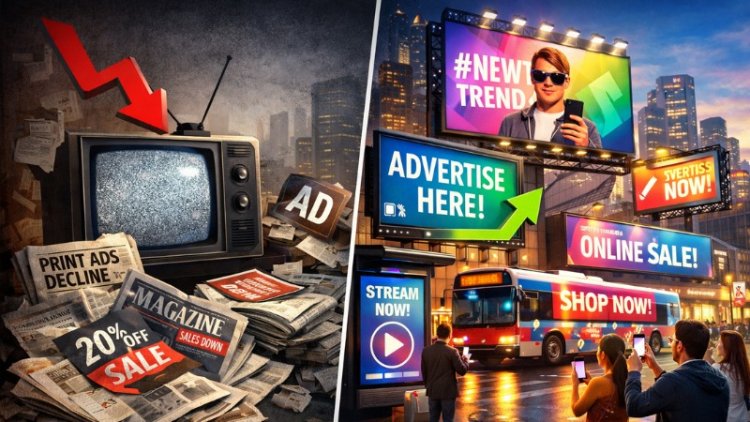
its position as the primary driver of growth while traditional channels steadily lose relative share. In 2025, digital advertising reached ₹71,621 crore, accounting for 59 percent of total advertising expenditure (AdEx). This milestone reflects not just rapid adoption, but a fundamental shift in how brands plan, measure, and execute communication strategies.
While traditional media continues to attract significant spends, its role within the media mix is being redefined. Television remained the largest traditional medium in 2025, with ad spends of ₹25,964 crore and a 21 percent share of total AdEx. Its continued relevance is anchored in live sports, high-impact entertainment properties, and strong regional programming that still deliver unmatched reach at scale. However, despite these strengths, television’s share has been on a gradual decline as advertisers weigh rising costs against limitations in targeting precision and real-time measurement.
Print followed television with advertising spends of ₹16,594 crore, contributing 14 percent of total AdEx. The medium continues to command trust and credibility, especially for categories such as government communication, education, retail, real estate, and public awareness campaigns. Yet print faces sustained pressure as brands increasingly favour platforms that offer performance tracking, dynamic optimisation, and audience-level insights—capabilities that print inherently struggles to match at scale.
Out-of-home (OOH) advertising stands out as a notable exception among traditional channels. With spends of ₹4,724 crore in 2025, OOH is the only traditional medium projected to grow over the forecast period. This resilience is being driven by the rapid expansion of digital OOH networks, better urban transit infrastructure, and growing advertiser appetite for premium, high-visibility formats in dense city environments. The integration of data, programmatic buying, and dynamic creatives is helping OOH reposition itself as a modern, measurable medium rather than a legacy format.
Radio and cinema remained smaller contributors to the overall AdEx, with spends of ₹1,501 crore and ₹935 crore respectively. Both channels continue to serve niche roles—radio for hyperlocal reach and frequency, and cinema for immersive, high-attention storytelling—but their influence on large-scale media planning remains limited.
The scale of the shift becomes clearer when viewed over a longer time horizon. In 2016, India’s advertising split stood at 12 percent digital and 88 percent traditional media. By the end of 2025, this ratio has flipped to 59:41. This dramatic rebalancing underscores that the current transformation is not cyclical or temporary, but structural in nature. Digital is no longer a supporting channel—it is the core around which media strategies are being built.
Looking ahead, this divergence is expected to widen further. Television’s share is projected to decline from 21 percent in 2025 to around 15 percent by 2027, while print is expected to drop from 14 percent to close to 10 percent. Digital, meanwhile, is forecast to approach nearly 70 percent of total advertising spends during the same period. Growth will be fuelled by formats that combine personalisation, measurable outcomes, and direct commerce integration—areas where digital platforms continue to outperform.
As digital takes centre stage, traditional media is being repositioned rather than replaced. Television, print, and OOH are increasingly deployed as high-impact amplifiers—used strategically for scale, trust, or contextual presence—while digital remains the always-on engine driving performance, engagement, and conversion. Together, this evolving media mix signals a reset in how brands allocate budgets, define effectiveness, and plan for long-term growth in an increasingly digital-first market.

 Sandhya