Connected TV Is Redrawing India’s Sports Advertising Playbook
Connected TV is reshaping sports advertising in India as brands shift budgets from linear TV to streaming platforms. Industry leaders cite audience migration, advertiser demand and platform maturity as key drivers.
 SociapaHQ
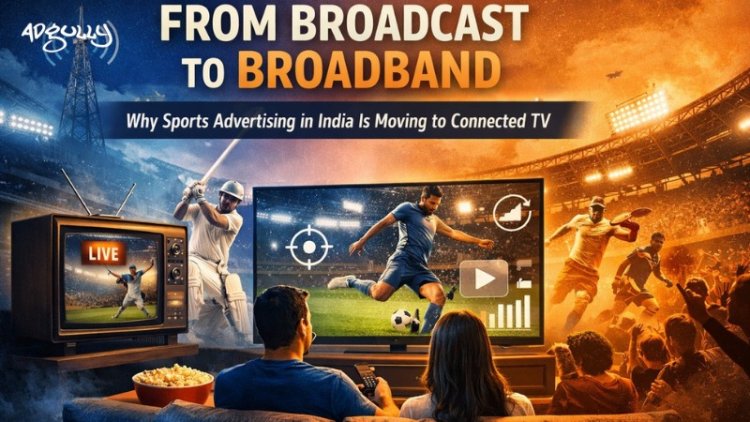
Sports advertising in India is undergoing a structural reset. What was once anchored in linear television and appointment viewing is increasingly being built around the connected screen in the living room. Connected TV (CTV) has moved from an experimental add-on to a defined line item in sports media plans, drawing budgets, measurement expectations and strategic focus along with it.
The shift is not driven by novelty. It reflects a practical recalibration of where audiences are watching, how advertisers want to evaluate performance and what streaming platforms can now deliver at scale. Mega tournaments still act as accelerators, but the momentum now extends beyond individual sporting events. The industry is moving toward a streaming-first operating model for sports advertising.
What distinguishes this moment is convergence. Audience migration laid the foundation. Advertisers sharpened their performance lens. Platforms matured technologically. Together, these factors have aligned to push CTV–sports partnerships into one of the most active reallocations in Indian media today.
Marketers increasingly frame the shift as consumer-led rather than media-led. Virat Khullar, Head of Marketing at Hyundai Motor India Limited, describes the trend as a response to audience behaviour rather than a speculative bet. “The surge in CTV sports partnerships is not driven by a single factor, it’s the convergence of evolving consumer behaviour, smarter platforms, better targeting and measurable outcomes. With 60mn+ households expected to be on CTV this year and over 75% viewership coming from NCCS AB audience, the CTV demand is only to grow. For Hyundai, the shift is consumer-led. When the living room experience moves to streaming, our responsibility is to show up there in a way that is contextual, relevant and measurable.”
Industry growth leaders describe the trend as structural rather than tactical. Nikhil Kumar, Chief Growth Officer at mediasmart, points to three reinforcing drivers: audience migration, advertiser demand and platform maturity.
“The momentum behind Connected TV (CTV) in sports isn’t being driven by just one factor, but by a powerful convergence of audience migration, advertiser demand and platform maturity,” he notes.
On audience migration, Kumar highlights the scale of the shift. In India, the CTV user base has expanded rapidly, with over 60–70 million CTV households and more than 129 million viewers engaging with content on connected screens. This reflects broader changes in video consumption, particularly for live and scheduled sports content.
Advertiser demand has also evolved. While sports have always delivered mass reach and emotional intensity, marketers increasingly expect targetability, measurement and outcome tracking alongside scale. CTV combines the impact of the big screen with data-driven targeting and attribution capabilities, narrowing the gap between brand and performance metrics.
Finally, platform maturity has reduced operational friction. Increased smart TV penetration, improved broadband infrastructure and programmatic buying tools have made planning and optimising campaigns more seamless. As sports rights increasingly sit on streaming platforms, integration with measurement systems further strengthens CTV’s position in media plans.
For agencies and brands, the implication is clear: CTV is no longer treated as a pilot budget during marquee tournaments. It is becoming a core pillar within integrated sports strategies that blend broadcast and digital. The reallocation signals not just a change in channel preference, but a redefinition of how sports advertising is bought, measured and evaluated in a streaming-first ecosystem.