Maggi Roasted by Veeba’s Wok Tok in Bold Print Ad
Veeba launches Wok Tok ad subtly taunting Maggi, promoting its healthier noodle offering with humor.
 Sandhya
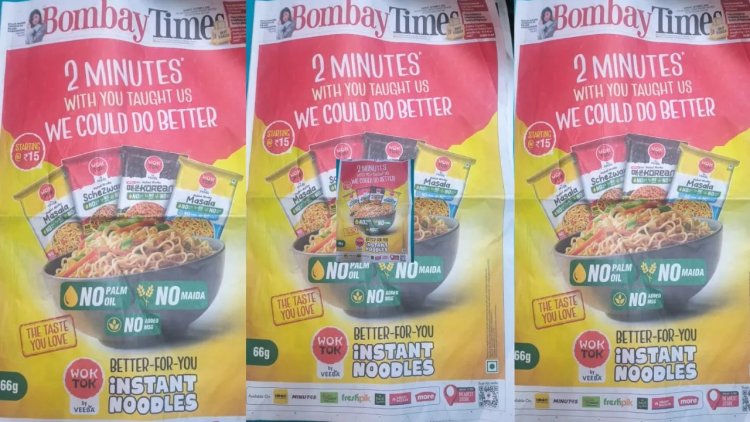
India’s instant-noodle market just got a spicy twist. Veeba, the brand better known for sauces and dressings, has jumped into the noodle fray — and launched with a cheeky dig at the established king, Maggi. In its new full-page print ad titled “Wok Tok”, the company teases the two-minute legacy of Maggi, while trying to position its noodle as a smarter, more health-aware alternative.
A roast without naming names
The ad opens with a line that reads:
“Two minutes with you taught us we could do better.”
That’s the entire barb. No explicit mention of Maggi, yet the reference is unmistakable — the “two minutes” slogan has long been associated with Maggi noodles. The bold move works: it evokes nostalgia and context, yet stakes out new territory.
In the layout, three major claims dominate: “No Palm Oil”, “No Maida”, and “No Added MSG” — each directly attacking well-known criticisms leveled at conventional instant noodles, and implicitly at Maggi’s formulations.
By cloaking its taunt in subtlety, Veeba positions this as more than a roasting stunt. It’s a statement: we’re not just another noodle brand — we believe we’ve solved the “guilty pleasure” dilemma.
Pricing, branding, and swagger
Wok Tok comes at ₹15 for a 66 g pack — comparable to many budget noodle options, meaning Veeba isn’t positioning it as a premium “better choice,” but rather as an accessible, upgrade.
Interestingly, tucked subtly into the ad near the vegetarian mark is a tiny disclaimer:
“Based on insights from a two-minute consumer survey with over 100 instant noodle lovers.”
It’s a wink, almost daring skeptics to doubt the insight. But the ad’s tone — playful, confident, meme-aware — suggests Veeba knows precisely the landscape it's playing in.
Veeba’s expansion beyond sauces and dressings into instant noodles is a notable pivot. The brand is clearly signaling ambition: to move from condiment specialist to broader snacking and mealtime categories.
Instant noodle arena: crowded, growing, contested
To understand how daring Veeba’s move is, you have to look at the battlefield. India’s instant noodle market is estimated between USD 1.8B to USD 2B (~₹15,900 crore), and is expected to grow to nearly USD 3.8B by 2028 at around 15% CAGR.
Yet within that, Maggi and ITC’s Sunfeast Yippee! combined command over 80% of market share.
Other players jockeying for space include Wai Wai, Marico’s Saffola Oodles, Ching’s Secret (Capital Foods), Nissin Top Ramen, HUL’s Knorr, and Patanjali. International and specialty Korean brands like Samyang and Nongshim also surface in urban / niche demand segments.
So Veeba’s ad isn’t just about humor — it’s a strategic statement to consumers: “We see you. We see the faults in your old favorites. We can do better.”
Will the roast land or backfire?
This is not the first time Maggi’s been publicly challenged. Previous campaigns — like those by Smith & Jones years ago — have poked at it. But Wok Tok’s version feels sharper, more culturally native, and built to ride social media amplification.
Still, it’s a balancing act. A roast that’s too heavy, or too aggressive, might trigger backlash from loyal Maggi fans. Consumers could perceive the tone as mean-spirited or opportunistic. The success will depend heavily on how audiences interpret both the jab and the product.
Veeba’s ad also puts pressure on itself — such bold positioning demands follow-through. If Wok Tok fails to deliver on taste, texture, or consistency (especially against a beloved benchmark), the roast could become a liability. But if it succeeds, the brand could rewrite part of the noodle narrative in India.
Final bite
In launching Wok Tok with a classy “shade” at Maggi, Veeba signals more than just a product debut. It’s challenging legacy, calling out perceived weaknesses, and courting attention all at once. Whether this bold move converts into lasting market share remains to be seen — but for now, the brand has ignited conversation.