Coca-Cola Bets on ‘Bondaaah’ as Sonic Branding Play Expands
Coca-Cola extends its sonic branding strategy in India with Yash’s “Bondaaah” campaign, building on Diljit Dosanjh’s viral “aaah” mnemonic to drive recall through sound.
 SociapaHQ
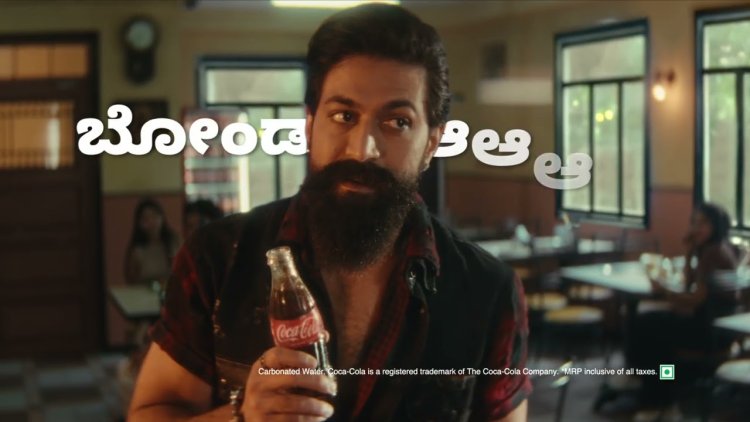
Coca-Cola appears to be deepening its sonic branding strategy in India, moving from Diljit Dosanjh’s viral “aaah” mnemonic to a new regional iteration with Kannada actor Yash, where the pairing of bonda and Coke becomes “Bondaaah.”
In the earlier campaign, Diljit’s exaggerated “aaah” delivery turned everyday foods like pizza, kulcha and bhatura into meme-friendly catchphrases. The creative leaned heavily into Punjabi humour and internet culture, allowing the elongated sound to become shorthand for refreshment. The new film with Yash applies the same audio device to a distinctly southern snack ritual. When bonda meets Coke, the word stretches — “Bondaaah” — transforming a simple food pairing into a repeatable hook.
The connective thread across both campaigns is not visual continuity but sound. In a beverage category saturated with high-decibel visuals and celebrity-heavy storytelling, Coca-Cola is experimenting with recall anchored in audio. A spoken or imitated phrase has greater portability across reels, shorts and user-generated content than a static visual gag. The mnemonic becomes performative — something audiences can mimic in everyday conversations, canteen settings or digital clips.
The stretched “aaah” functions as more than a descriptor of taste. It ritualises the food moment itself. Whether it is bhatura in North India or bonda in the South, the pronunciation becomes a playful signal that the pairing is incomplete without Coke. By localising the snack but standardising the sonic treatment, Coca-Cola retains brand coherence while adapting to regional food cultures.
This approach also reflects a broader shift in how large FMCG brands are thinking about mnemonic branding. With shrinking attention spans and fragmented media consumption, sonic identity often outperforms elaborate narratives. A recognisable audio cue can cut across languages and formats, travelling through memes, remixes and imitation videos more fluidly than dialogue-heavy storytelling.
Coca-Cola is not alone in leaning into food-based associations. Thums Up has previously positioned itself alongside biryani, most notably through campaigns featuring Shah Rukh Khan. However, while those efforts emphasised pairing through storytelling and visual appetite appeal, Coca-Cola’s current approach foregrounds sound as the central asset.
The timing is strategic. As summer approaches, the beverage aisle is more competitive than ever, with zero-sugar colas, flavoured sparkling waters and zero-alcohol alternatives vying for attention. Traditional cola brands no longer compete only on distribution or celebrity presence; they compete on cultural embedment. A phrase that slips into everyday vocabulary can offer an edge in recall without escalating production budgets.
By replicating the “aaah” construct across regions, Coca-Cola is effectively building a modular sonic framework. The snack changes, the language shifts, but the elongated sound remains. If adopted widely by users, “Bondaaah” could follow the same trajectory as its Punjabi predecessor — migrating from scripted ad to casual speech.
For brands operating in high-frequency, low-involvement categories, the lesson is clear: sometimes what sticks is not what audiences see, but what they say.