Amazon sees non-metro surge in B2B sales
Non-metro B2B orders jump 60-70% as Amazon expands fulfilment ahead of festival season.
 Sandhya
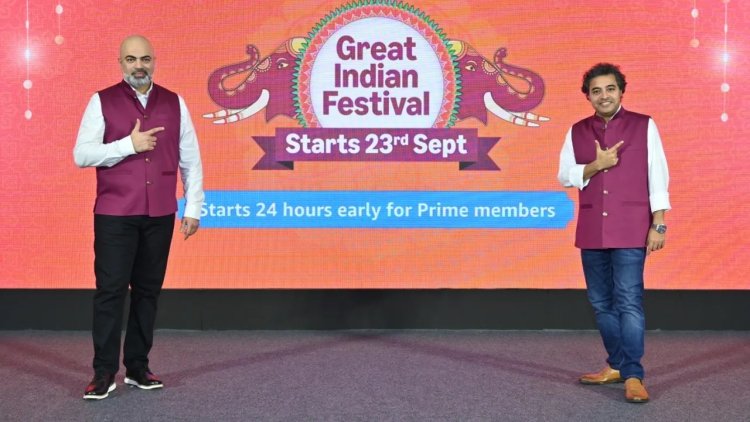
As India gears up for its biggest shopping season, Amazon is witnessing a sharp uptick in B2B (business-to-business) e-commerce activity—especially from beyond the metros. The company says non-metro centres such as Kolhapur and Aurangabad posted year-on-year growth rates of 71% and 65%, respectively, in business purchases.
Growth Trends & Regional Dynamics
Amazon Business—the B2B arm operating within Amazon’s broader marketplace—has long offered bulk pricing, GST-compliant invoicing, and credit facilities to enterprises procuring goods. In recent months, the company says, registrations and orders from non-metropolitan cities have outpaced growth in tier-1 urban centres.
View this post on Instagram
Within Maharashtra—Amazon Business’s largest state market—non-metro regions are driving much of the growth. While Mumbai and Pune naturally contribute high volumes, the surge in smaller cities is redefining the regional balance.
Amazon says it now has 1.9 lakh sellers from Maharashtra on its platform. In tier-2 and tier-3 districts, the number of “crorepati sellers” (i.e. those crossing ₹1 crore in annual sales) has doubled year over year. These sellers are increasingly supplying to clients across India, including large businesses in remote locations.
Festive Preparations & Infrastructure Buildout
With the Great Indian Festival sale already underway (starting September 22 for Prime users, September 23 for others), Amazon is laying heavy emphasis on its ability to support the surge in orders—including B2B orders.
To underpin service capability, Amazon is expanding its logistical footprint:
-
Three new fulfilment centres in Maharashtra (Thane, Nagpur, Pune) are now live, bringing the state’s total to six centres.
-
In addition to fulfilment centres, Amazon has added six sorting centres and 75 new delivery stations nationwide.
-
To bolster delivery speed, Amazon is rounding out its “I Have Space” programme—a network of 28,000+ local mom-and-pop or kirana stores that act as micro-delivery nodes.
-
On the air logistics side, Amazon is renting cargo space on passenger flights and has deployed two dedicated cargo aircraft.
-
To handle the seasonal order load, Amazon has created 1.5 lakh additional jobs, with women accounting for 32% of new hires (its largest share outside North America).
Voices & Strategic Rationale
Amazon’s directors highlight that the rise in non-metro B2B trade is a strategic inflection point. Mitranjan Bhaduri, Director of Amazon Business, said the shift shows that it’s not just major urban centres driving e-commerce — the growth is broad-based across the country.
Karan Chugh, Director of Operations, emphasized Amazon’s commitment to infrastructure: “With expansion of fulfilment, sorting, delivery and network capacity, we’re reinforcing our promise to deliver unmatched value, speed and convenience to businesses across the state.”
Anecdotes shared by Amazon underline the geographic expansion: a furniture vendor in Maharashtra servicing a manufacturing plant in Orissa; a laptop seller in the state supplying one of India’s airlines. These show that the “distance” barrier is receding.
Implications & Challenges
Opportunities:
-
Broader reach: Non-metro demand expansion opens white spaces for B2B penetration in underrepresented markets.
-
Seller empowerment: Local sellers with scale are now able to compete nationwide, diversifying their buyer base.
-
Cost efficiencies: A more distributed network reduces logistics bottlenecks and last-mile friction.
-
Festive leverage: The uptick during the festival season could drive retention, not just one-time spike.
Risks & Considerations:
-
Operational complexity: Managing numerous smaller delivery points, micro-nodes, and rural logistics adds operational friction.
-
Service consistency: Ensuring punctual, reliable shipping and supply in remote areas is harder.
-
Margin pressure: Serving remote or low-density areas might raise cost per delivery, squeezing margins.
-
Sustainability post-festival: The surge may taper after the festival; maintaining momentum will require ongoing investment and strategy.
Outlook
Amazon’s data suggests that as India’s e-commerce infrastructure deepens, non-metro regions are becoming major growth engines rather than fringe markets. The festival season acts as an accelerant—but sustained capability investment (logistics, fulfilment, micro-delivery nodes) is the underpinning.
If execution holds, Amazon Business is well placed to translate seasonal spikes into structural growth, solidifying its leadership across urban and rural India alike.