Dentsu FY2025 Loss Widens as Overseas Write-Downs Offset Stable Japan Performance
Dentsu reported a wider FY2025 net loss after major impairments in the Americas and EMEA, despite stable growth in Japan. The company has suspended dividends as it navigates uneven global demand.
 SociapaHQ
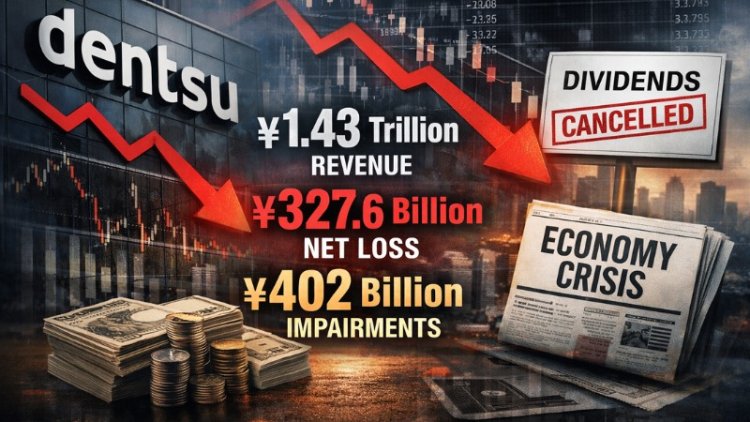
Dentsu Group closed the year ended December 31, 2025 with a deeper reported loss after significant impairment charges in international markets overshadowed otherwise steady operating trends.
Revenue rose 1.7% year on year to ¥1.43 trillion, while net revenue edged down 0.3% to ¥1.19 trillion. Underlying operating profit declined 2.1% to ¥172.5 billion, and margin slipped to 14.4% from 14.8% previously. The statutory picture was more severe. After write-downs, the group posted an operating loss of ¥289.2 billion versus a loss of ¥125 billion in FY2024. Net loss attributable to owners widened to ¥327.6 billion, with most of the impact coming from the Americas and the Europe, Middle East and Africa businesses.
For clients and investors, the divergence between underlying activity and reported earnings highlights how historical acquisitions and goodwill valuations continue to weigh on holding companies in a slower-growth environment. Demand has not collapsed, but expectations built into earlier balance sheets are being reassessed.
Japan provided relative stability. Organic net revenue grew 6.2%, supported by internet advertising as well as business and digital transformation assignments. Even with higher talent investment, underlying operating profit in the home market increased 6.1%, with margins staying above 24%. The domestic unit remains the earnings anchor for the group.
Outside Japan, conditions were uneven. The Americas recorded a 3% organic decline as the US market softened. EMEA slipped 1.8% amid macro pressure in major economies. In Asia-Pacific excluding Japan, organic net revenue fell 6.8%, largely due to Australia, although India, Thailand and Taiwan delivered comparatively firmer performances.
Balance sheet metrics tightened as assets were marked down. Total assets fell to ¥3.2 trillion, while equity attributable to owners dropped sharply, pushing the equity ratio to 11.7% from nearly 20% a year ago. Cash and cash equivalents ended the period at ¥295.2 billion, down from ¥372 billion, reflecting financing outflows including repayments and bond redemptions.
The company also moved to conserve capital, announcing no dividend for FY2025 and guiding for none in FY2026. For shareholders accustomed to payouts, that is a clear signal that stabilisation takes precedence over distribution.
Looking ahead, Dentsu expects a gradual recovery rather than a rebound. For FY2026 it forecasts revenue growth of 3.9% and net revenue expansion of 2.7%. Underlying operating profit is projected at ¥166.3 billion, suggesting continued margin pressure as transformation spending continues.
Management cited geopolitical tension and patchy advertising demand as persistent risks. Japan is expected to remain comparatively resilient, but overseas markets may take longer to normalise.
For the global agency landscape, the results underline a familiar pattern. Mature networks are still generating substantial activity, yet they must digest legacy valuations while adapting to a market that prizes flexibility, technology integration and cost control. Write-downs clean the slate, but they also make visible how expensive past optimism can become.
The coming year will test whether a leaner structure and steadier domestic base can offset international volatility. Investors will be watching for evidence that operational resilience can translate into cleaner reported numbers.